

 TIG Self-Advocacy Guidance Google Site
 Wisconsin County Community on Transition (CCoT) Toolkit
 Resources
WiTransition App Sample PTP Student Report
Content Areas Indicator 13 - Postsecondary Transition Plan
Resource Type Document

WiTransition App Paper Copy
Content Areas Indicator 13 - Postsecondary Transition Plan
Resource Type Document

How to Use the WiTransition App For Educators
Content Areas Indicator 13 - Postsecondary Transition Plan
Resource Type Document

How to Use the WiTransition App For Families
Content Areas Indicator 13 - Postsecondary Transition Plan
Resource Type Document

How to Use the WiTransition App For Students
Content Areas Indicator 13 - Postsecondary Transition Plan
Resource Type Document

Website: Supporting Justice Involved Youth with Disabilities
Resource Type Link
The Transition Improvement Grant has developed this resource to support individuals who support justice involved youth with disabilities. It offers helpful resources, strategies, and best practices designed to foster a positive learning environment and enhance the educational experience for justice involved youth. This resource also focused on best practices to ensuring a smooth transition to post-school support that includes increased family/caregiver engagement, education, employment and mental health.

Transition Activities Timeline Considerations
Content Areas Indicator 13 - Postsecondary Transition Plan, Self Advocacy
Resource Type Link
The Transition Improvement Grant (TIG) has compiled a resource to encompass transition activities to consider at all grade levels to assist youth, families and educators in navigating through the transition process. Areas to reflect on and consider activities include SelfDetermination and Self-Advocacy, Employment, and Postsecondary Education and Training. Adapted from the Opening Doors series by the Wisconsin Department of Instruction.
WiTransition Sample PTP Student Report
Content Areas Self Advocacy
This is a sample of the student report that is created once the student has gone through the steps using the WiTransition App.

Forms of Family Capital Quick Reference
Resource Type Document
Family engagement goes beyond school-based participation. Families bring diverse forms of capital— knowledge, resources, and strengths—that enrich planning and support for their children. This document provides examples of different types of capital.

Sample Listening Session Prompts for Engaging Families in the Secondary Transition Process Presentation
Resource Type Document
This guide is designed to help educators and transition planning teams better understand, select, and use transition assessments to support students with IEPs as they prepare for life after high school. Transition assessments help uncover a student's preferences, interests, needs, and strengths (PINS) through collecting valuable data. This information shapes the Postsecondary Transition Plan (PTP) and ensures the Individualized Education Program (IEP) is tailored to each student’s unique goals.

Strategies for Engaging Families in the Secondary Transition Process Presentation
Resource Type Document
Approaches that center community, context, and family strengths. Identify traditional approaches to family engagement in secondary transition, explore innovative and community-driven strategies for strengthening partnerships, reflect on current practices, share ideas, and identify at least two strategies to apply in your school or district, learn methods for evaluating family engagement and its impact on post-school outcomes, and develop an action step for implementing at least one new family engagement approach or tool.

Transition Assessment Guide Presentation
Content Areas Best Practices
Resource Type Document
Explore the structure and purpose of the TIG Transition Assessment Guide and how it supports transition planning, and identify practical ways to apply the guide and available assessments to meet the diverse needs of students.

Transition Assessment Guide
This guide is designed to help educators and transition planning teams better understand, select, and use transition assessments to support students with IEPs as they prepare for life after high school.

Age-Appropriate Transition Assessment
The IEP must include appropriate measurable postsecondary goals based upon age-appropriate transition assessment related to training, education, employment, and where appropriate, independent living skills. 34 CFR 300.320(b)(1), IDEA

TIG Professional Learning Opportunities – Save the Date 2025-2026
Postsecondary Transition Plan and Students with Complex Support Needs
Content Areas Best Practices, Indicator 13 - Postsecondary Transition Plan
Resource Type Document
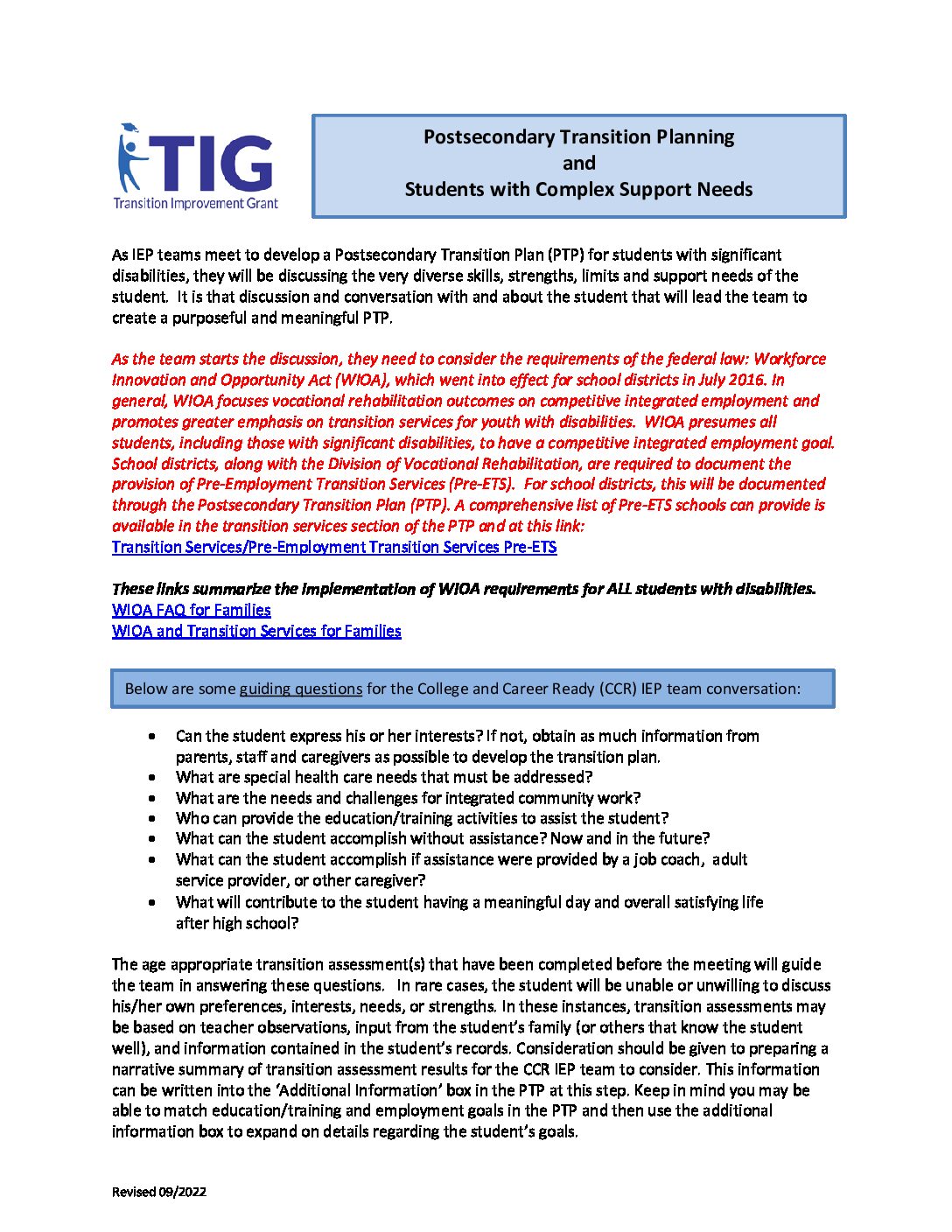
This is a wonderful handout with scenarios and sample PTPs for student with significant disabilities.
Ley de Innovación y Oportunidades para la Fuerza Laboral – WIOA FAQ for Families – Spanish
Content Areas Indicator 13 - Postsecondary Transition Plan
Resource Type Document
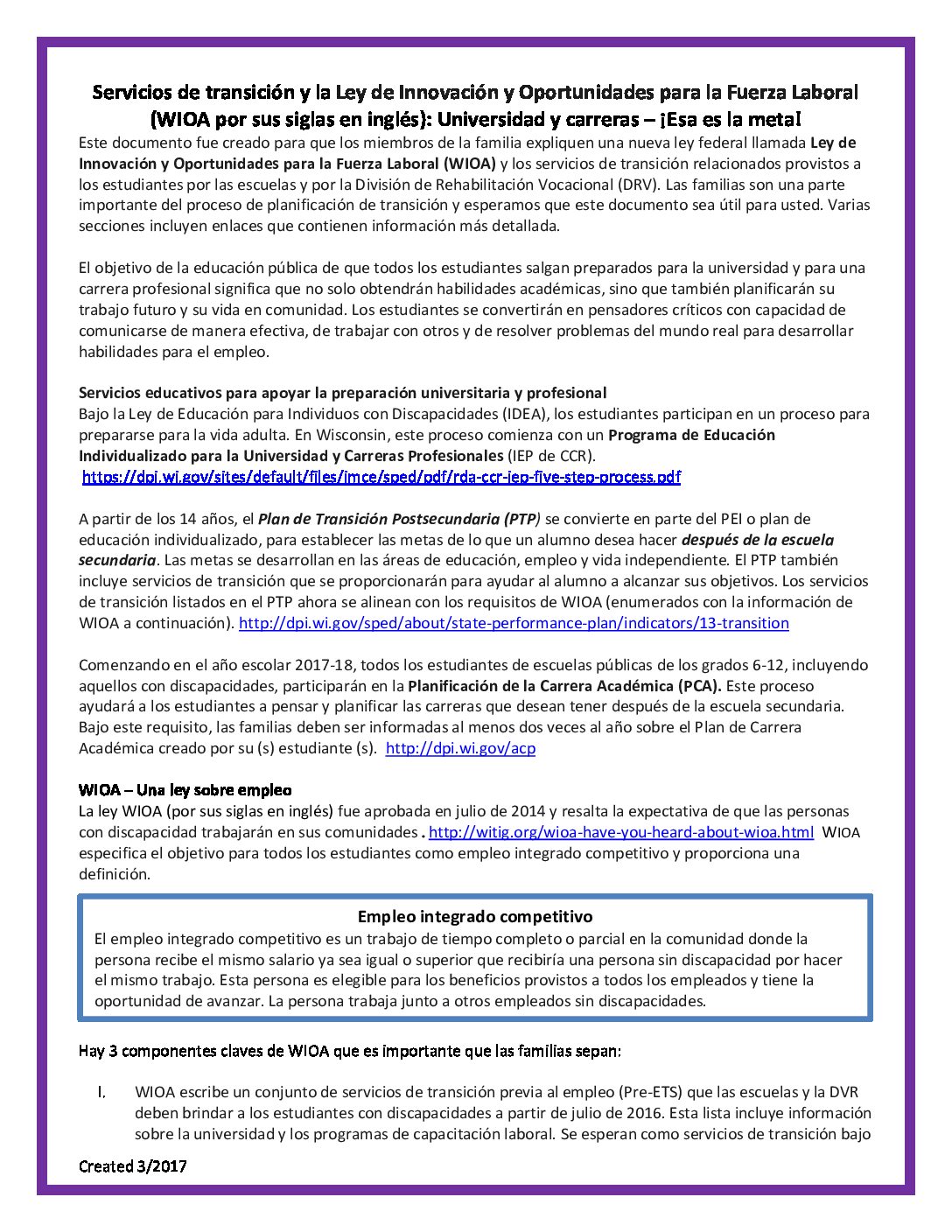
¿Qué es la Ley de Innovación y Oportunidades para la Fuerza Laboral (WIOA por sus siglas en inglés)?WIOA es una ley federal aprobada en julio de 2014 que incluía nuevas responsabilidades para las escuelas y para la División de Rehabilitación Vocacional (DRV) sobre apoyar a los estudiantes y jóvenes con discapacidades en su transición de la escuela a la universidad y / o a un empleo integrado competitivo. WIOA tiene requisitos específicos para garantizar que los estudiantes con discapacidades reciban servicios de transición para ayudarlos a alcanzar sus metas después de graduarse de la escuela secundaria. Los requisitos de la WIOA para las escuelas entraron en vigencia en julio de 2016. Algunos de los requisitos de la DRV entraron en vigencia inmediatamente cuando se aprobó la ley y otros se implementaron en julio de 2016.
Servicios de transición y la Ley de Innovación y Oportunidades para la Fuerza Laboral – Transition Services for Families – Spanish
Content Areas Indicator 13 - Postsecondary Transition Plan
Resource Type Document
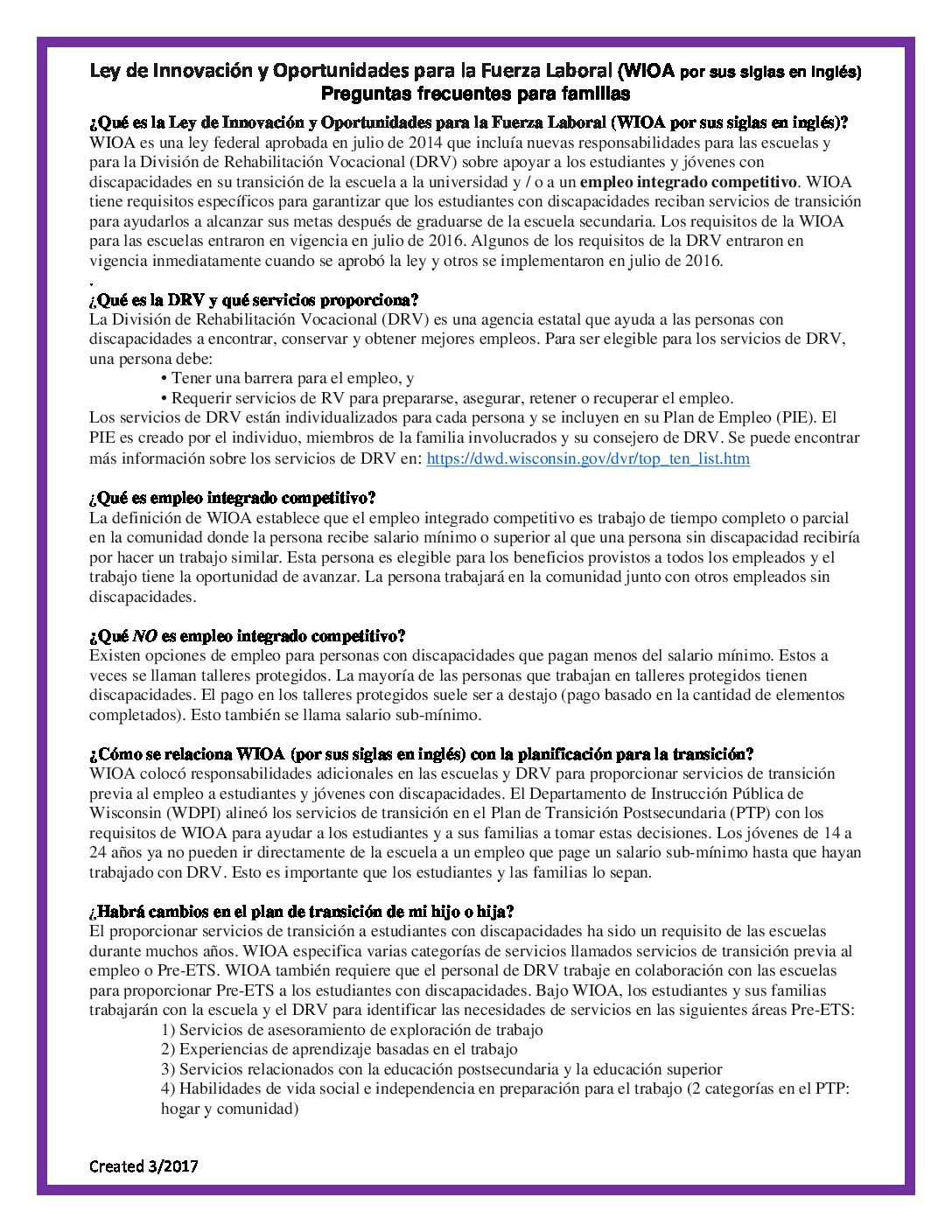
Este documento fue creado para que los miembros de la familia expliquen una nueva ley federal llamada Ley de Innovación y Oportunidades para la Fuerza Laboral (WIOA) y los servicios de transición relacionados provistos a los estudiantes por las escuelas y por la División de Rehabilitación Vocacional (DRV). Las familias son una parte importante del proceso de planificación de transición y esperamos que este documento sea útil para usted. Varias secciones incluyen enlaces que contienen información más detallada.
WIOA Frequently Asked Questions for Families
Content Areas Indicator 13 - Postsecondary Transition Plan
Resource Type Document
This document lists several commonly asked questions regarding WIOA from the parent's perspective. Answers to these questions, as well as useful resource links are included.

WIOA and Transition Services for Families: College and Careers – That’s the Goal!
Content Areas Best Practices, Indicator 13 - Postsecondary Transition Plan
Resource Type Document
This document was created for family members to explain a new federal law called the Workforce Innovation and Opportunity Act (WIOA), and the related transition services provided to students by schools and the Division of Vocational Rehabilitation (DVR). Families are an important part of the transition planning process and we hope this document is helpful to you. Several sections include links to more detailed information.